Most writing about AWD rice carbon projects stops at the agronomy: the paddy dries, methane falls, credits follow. The hard part sits between the second step and the third. Somebody has to prove that tens of thousands of smallholders actually changed how they water their fields, plot by plot and season by season, to a standard a verifier will sign off.
This case study follows one programme that got there. Kosher Climate India’s alternate wetting and drying programme in West Bengal has had its first three project activities certified by Gold Standard, with credits issued. CropIntellix was the programme’s digital MRV technology partner. What follows covers what the project is, what the evidence had to show, and what carries over to other AWD rice carbon projects.
The project at a glance
| Project developer | Kosher Climate India Pvt Ltd |
|---|---|
| Location | West Bengal, India |
| Practice | Alternate wetting and drying (AWD) in irrigated paddy |
| Standard | Gold Standard for the Global Goals |
| Methodology | Methane emission reduction by adjusted water management practice in rice cultivation |
| Certified project activities | GS23159, GS23160, GS23161 |
| Scale | Over 35,000 farmers and more than 15,000 hectares |
| Credits | More than 133,000 generated |
| Digital MRV | CropIntellix |
The scale and credit figures are the developer’s own, as published in Kosher Climate’s announcement. The project IDs, developer, location and certification status can be checked on the Gold Standard registry. The last section of this article explains how.
Why AWD suits West Bengal paddy
Conventional paddy is kept under standing water for most of the season. Waterlogged soil starves of oxygen, and the bacteria that break down organic matter there release methane. AWD interrupts that cycle. The field is allowed to dry down and is then re-flooded, so the soil spends less of the season anaerobic. The registry’s own project description puts the reduction at as much as 48% compared with continuous flooding.
The developer also reports up to 30% less irrigation water. For a smallholder that saving shows up in the pumping bill. It is also why AWD gets adopted in the first place, before any carbon payment arrives. The agronomy is covered in depth in how AWD carbon credits are generated, so this article stays on what it took to evidence it.
Why scale is the hard part in an AWD rice carbon project
The registry shows how the programme is built. The West Bengal activities sit under a single Gold Standard programme, “Improved agricultural practices for rice cultivation in India”, as separate project activities. Each activity goes through certification on its own. Three are certified so far, and further West Bengal activities are listed and working towards the same status.
Every new activity has to clear the same evidence bar as the first. A verifier does not accept “35,000 farmers practised AWD” as a statement. They sample individual plots and ask to see the trail behind each one: who the farmer is, where the plot is, whether the pipe was installed in it, and whether the field actually dried.
From the field: one farmer’s file, multiplied by 35,000
On the ground, that trail is a file of documents for every farmer, every season:
- identity documents and a photograph of the farmer
- land records for each plot
- the plot boundary and its attributes
- photographs of the AWD pipe installation
- photographs of every aeration event through the season
For 50 or 100 farmers, a careful team can collect and check this by hand. At 35,000 farmers it became the programme’s biggest operational challenge. Collecting the documents was only half of it. Each one also had to be checked, at each stage, to confirm it was genuine and belonged to the right farmer and the right plot.
Mistakes made early are expensive later. A farmer enrolled twice, or a boundary drawn over a neighbour’s field, carries forward. Every pipe photograph and aeration record attached to that plot is then built on a bad foundation, and a verifier will find it. The failure modes are set out in why agricultural carbon data fails audit.
A verifier does not audit a programme. They audit plots, one at a time, and the programme passes only if the plots do.
Stage gates: nothing moves forward until it is approved
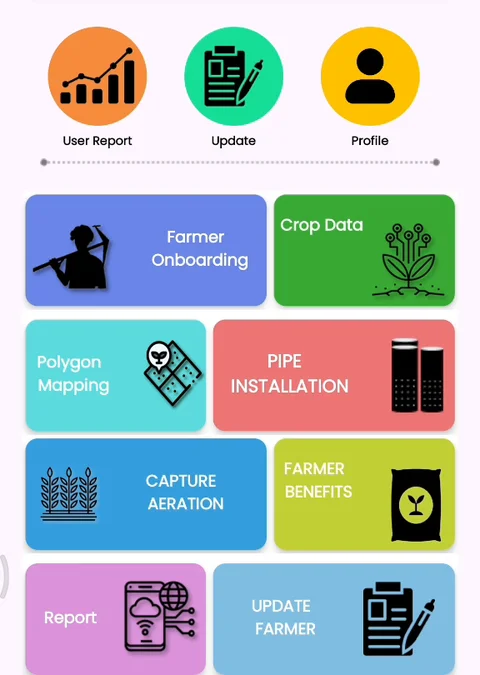
The answer was to build the checks into the workflow rather than leave them to a final audit. The AWD app and dashboard were set up as a series of gates. A record can only move to the next stage once the stage before it has been reviewed and approved:
Farmer onboarding
Identity, photograph and land records are captured and reviewed. Wrong or duplicate farmers are stopped here and cannot be carried into the next step.
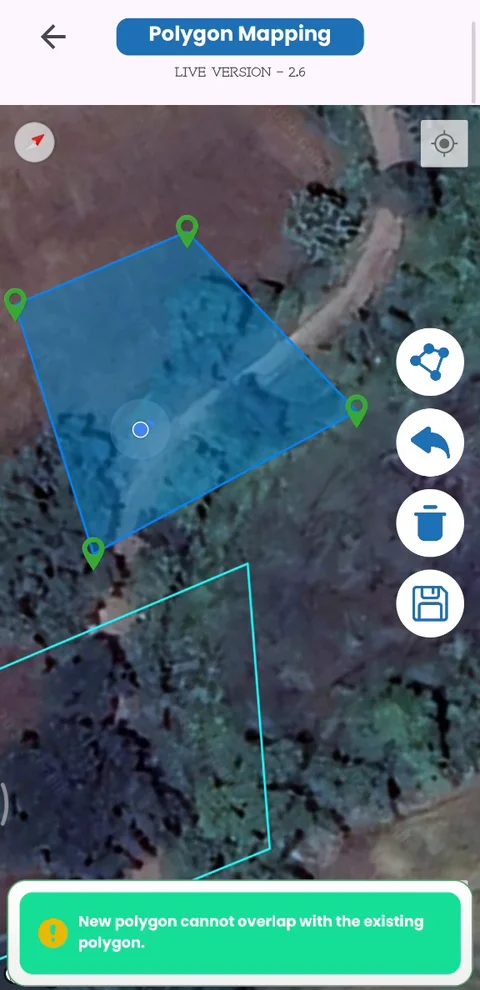
Polygon mapping
Only approved farmers reach plot mapping. The app refuses a boundary that overlaps a plot already enrolled.
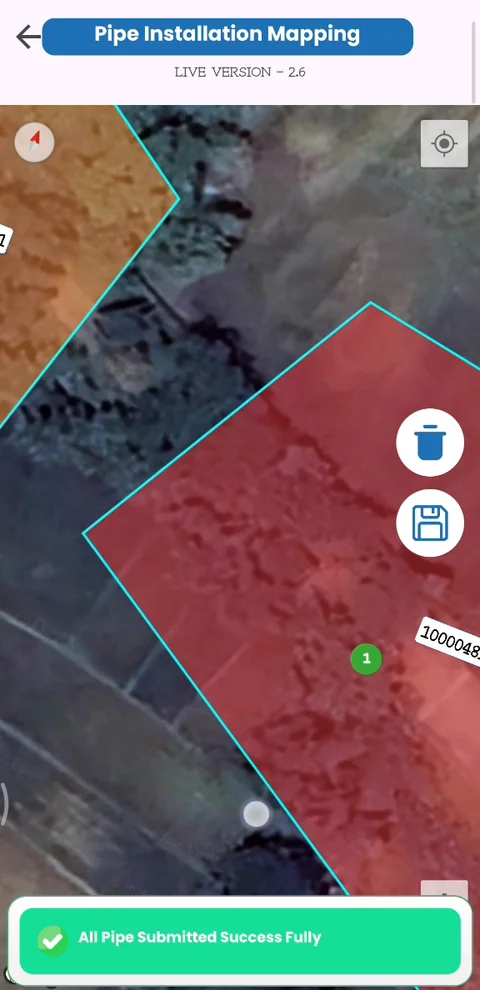
Pipe installation
Only farmers with an approved plot boundary reach pipe installation. The pipe is pinned inside that boundary with a geo-tagged, time-stamped photograph.
Aeration events
Only approved pipe installations open up aeration capture. Each dry-down is photographed inside the plot’s geo-fence.
Rejected records do not disappear. They go back to the field user who collected them, with the record flagged for re-collection or re-submission. Correct information always takes priority over speed, and the problem is fixed at the stage where it happened, not discovered seasons later.
Many validators, one queue
Stage gates create a risk of their own. If approvals are slow, field teams sit idle, waiting for permission to start the next step while the season moves on. With 35,000 farmers, a single reviewer would have become the bottleneck within days.
So validation was spread across a team. The dashboard aligns each incoming record with what has already been approved for that farmer and plot, and several data validators work through the queue at the same time. Records arriving from the field are checked, validated and approved quickly, and field users can move on to the next stage without delay.
Real-time analytics for the project developer
A programme this size cannot be managed from a monthly report. The dashboard gives live analytics on the data as it arrives, broken down by field user, state, taluka and village, across a set of KPIs. The project developer can see where enrolment is moving, where approvals are stuck and which villages are behind, while there is still time in the season to act on it.
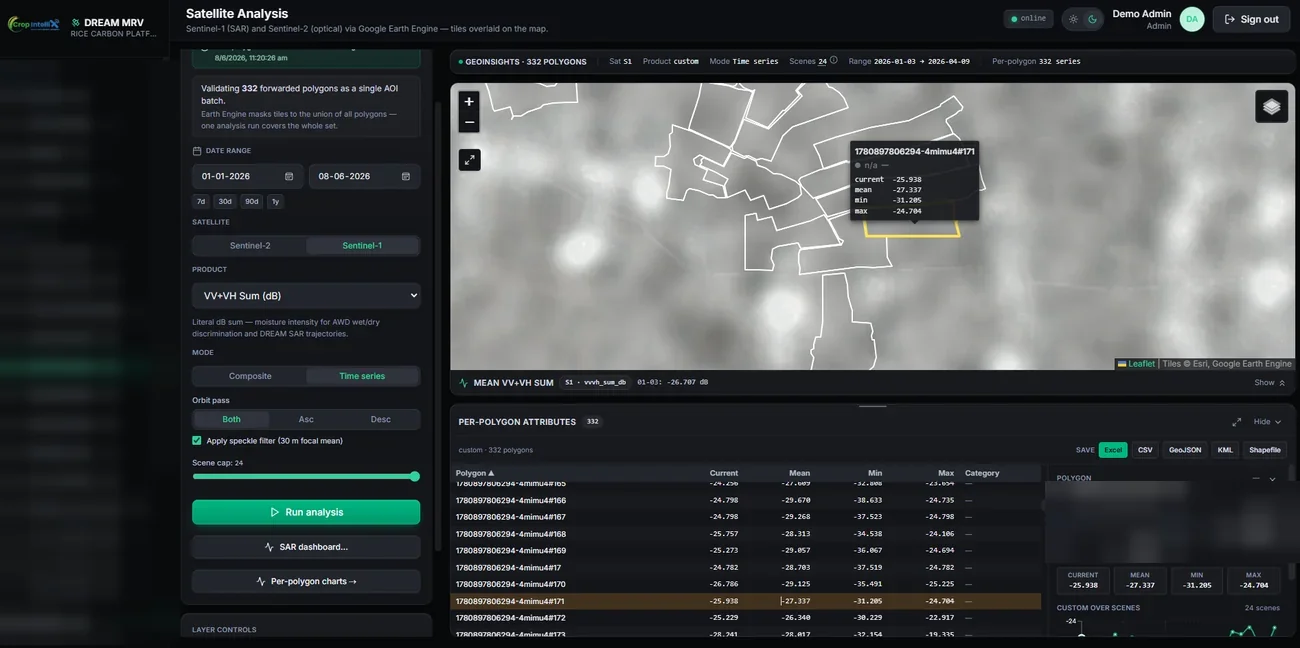
Satellite analysis adds an independent check on top. Radar time series run over every plot boundary corroborate what the field records say about flooding and drying, across every plot rather than a visited sample.
Three teams, one record
No single organisation could have carried this alone, and the record held together because each team owned its part of it:
- The project developer ran the programme, the farmer relationships and the registry process. Real-time analytics kept them informed of where every activity stood.
- The ground team, more than 200 field users, collected the data village by village and re-collected whatever was sent back.
- CropIntellix built and ran the app, dashboard and validation workflow. When the field reported a problem, the fix reached field users the same day.
That last point matters more than it sounds. In a season, a week-long wait for an app fix means missed aeration events that cannot be captured later. Same-day fixes kept the record complete. The AWD dMRV platform page covers the app and dashboard in more detail.
Checking the claim on the registry
A certified project should not need to be taken on trust, this one included. Anyone can check it on the public Gold Standard registry by searching for the three certified activities:
- GS23159 — Improved agricultural practices for rice cultivation in West Bengal, BVPA 01
- GS23160 — BVPA 02
- GS23161 — BVPA 03
Each entry names the developer, the location and the certification status, and links to the project documents. That registry trail is worth more than any case study, including this one. If you are assessing an MRV provider for your own programme, ask which registered projects their data has been through, then look those projects up yourself.
What carries over to other rice programmes
Four lessons from this programme apply to any AWD rice carbon project, whatever its size or standard:
- Check at every stage, not at the end. A wrong farmer stopped at onboarding costs one re-collection. The same error found at verification can cost every record built on top of it.
- Send rejections back to the person who can fix them. A rejected record should go straight to the field user who collected it, while they can still return to the plot.
- Staff the approvals, not just the collection. Gates only work if approvals keep pace with the field. Plan validator capacity alongside field capacity.
- Settle the methodology before you enrol. It decides what evidence counts. The routes are compared in the Gold Standard DREAM methodology explained, which also covers stacking AWD with other rice practices.
Related reading
The AWD dMRV platform covers field capture and the satellite engine. The DREAM platform covers digital rice projects that stack several practices.
- Rice carbon credits: how methane reduction is measured
- AWD carbon credits: how alternate wetting and drying generates them
- DSR vs AWD: choosing the right rice practice for a carbon programme
- Why agricultural carbon data fails audit
Talk to us about your programme
If you are planning an AWD rice carbon project and want to see what plot-level evidence would look like for your farmers, we are happy to walk through it. We usually reply within one business day.
Book a demo →